
San Juan

Garita del Diablo in San Juan ~photo courtesy of: www.pharmacogenomicsforum.org
San Juan is the capital and most populous city in Puerto Rico. Founded in 1521 by Juan Ponce de León, who named it City of Puerto Rico ("Rich Port"). The capital of Puerto Rico is the oldest city under U.S. jurisdiction, but some people argue than St. Augustine, Florida, founded in 1565 is the oldest city in the continental United States.
The history of San Juan begins a long time before its official foundation, in 1493, during his second voyage, Christopher Columbus landed in Puerto Rico. He named the island "San Juan Bautista", in honor of John the Baptist. But was not until 1508, that the Spanish government appointed Juan Ponce de León as the first governor of the island. He founded the original settlement in Caparra, now known as Pueblo Viejo, behind the almost land-locked harbor just to the west of the present metropolitan area and the city quickly became Spain's most important military outpost in the Caribbean.
A year later, the original settlement was relocated to a nearby coastal islet (to the site of what is now called Old San Juan) and named Puerto Rico (Rich Port). Sometime during the 1520s, confusion over the names led to a switch, the island took the name of Puerto Rico and the town became San Juan.
Today, San Juan is known as "La Ciudad Amurallada" (the walled city) and is one of the biggest and best natural harbors in the Caribbean and is the second oldest European-founded city in the Americas (after Santo Domingo, which was officially founded on August 5, 1498.)
Arroyo
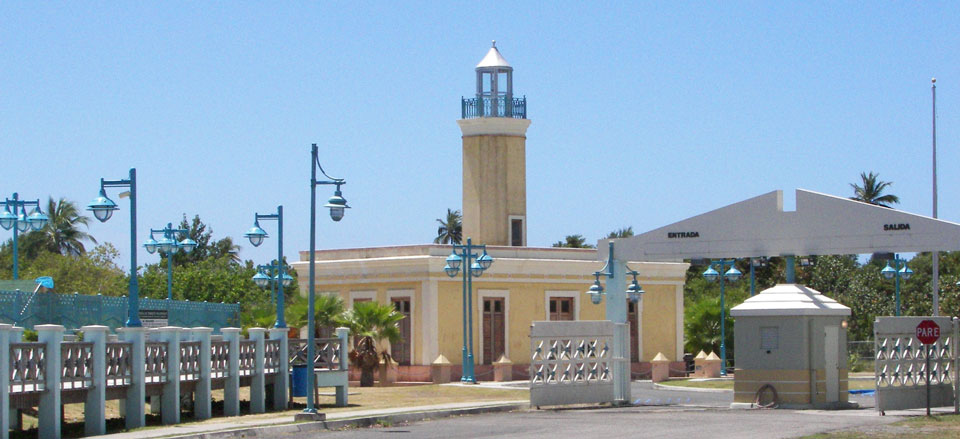
Punta Guilarte Lighthouse ~photo ©2006 Adamy Diaz
Arroyo is located in the region known as the Southern Coastal Valley, a very dry region. Bordering the Caribbean Sea, east of Guayama and northwest of Patillas. Arroyo's highest peaks are Yaurel (686 m), Corazón (605 m), and Ancones (270 m).
Arroyo is known as Pueblo Ingrato-Pueblo Grato. The town was founded in December 25, 1855. Arroyo ("creek" in English) derives its name from the small stream from which weary travelers in the past stopped for a drink of water and to rest.
Jayuya

Cemi Museum ~photo ©2006 Adamy Diaz
Jayuya is known as "La Capital Indigena" (the indigenous capital). Jayuya was founded in 1883 but made an independent municipality in 1911. Derives its name from a local Indian Chief Hayuya which means "lugar de guayo" (place of guayo).
Jayuya, tucked into the rugged northern border of Toro Negro Forest Reserve (7,000 acres include Puerto Rico's highest peak. Spectacular views extending to the Atlantic and the Caribbean), promotes its Indian heritage and its wood caverns. A former Jayuyan coffee estate has been converted into a parador, with a little-used path to Cerro de Punta. The Cerro de Punta, with an elevation of 4,389 feet (1,338 meters) above sea level, is the highest point on the Island.
Jayuya is known for its skilled wood carvers.
Among its monuments are the Catholic church, the statue of Nemesio R. Canales and the bust of the Indian leader Jayuya, by the Puerto Rican sculptor Tomás Batista.
Jayuya is located in the center region of the island, north of Ponce; east of Utuado; and west of Ciales.
There are many well-known "jayuyanos", among them: poet Nemesio Canales.
Mayaguez
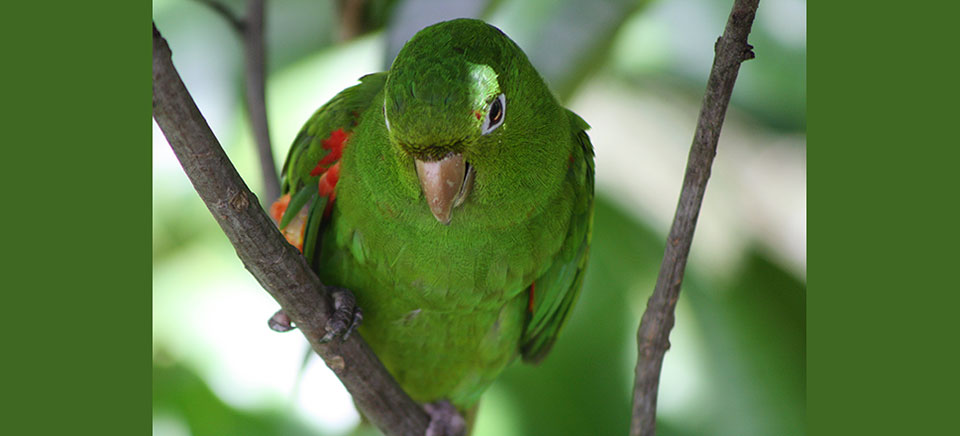
Parrot at Mayaguez Zoo ~photo courtesy of commons.wikimedia.org
Mayagüez is known as "La Sultana del Oeste" (the sultana of the West). Founded in 1760 by Faustino Martínez de Matos, Juan de Silva and Juan de Aponte.
Originally named "Our Lady of the Candelaria of Mayagüez", but dwindling tradition from the Indian name of its river, the Yagüez River (the word means "clear waters") the city was eventually named just Mayagüez. Mayagüez (pronounced Mah-yah-goo-ehz or Mah-yah-GWEHZ) is a variation on this name, which means "Land of the Clear Waters".
Mayagüez is located in the west coast, north of Cabo Rojo, Hormigueros and San Germán; south of Añasco; and west of Las Marías and Maricao.
Today, Mayagüez is the fifth-largest city and is considered one of the most important cities in the island. The city itself is centered around the impressive Spanish-style Plaza Colon, a tribute to Christopher Columbus, whose stature stands in the middle of the square, surrounded by 16 bronze statues.
In addition, Mayagüez has become a major college town because with the establishment of the UPRM, the Eugenio Maria de Hostos Law School and the Pontiff Catholic University of Puerto Rico.
Among Mayagüez's main attractions you will find the Yagüez Theater and Mayagüez Post Office, which are considered historic landmark buildings, both located on McKinley Street.
Mayagüez is home of the only Zoo in the island, Juan A. Rivero Zoo (commonly known as Mayagüez Zoo), home of numerous birds, mammals and reptiles (including Bengal tigers, and Andean condors among others). Cages and open compounds stand in an attractively landscaped setting of small islands, a lake, tropical vegetation and children's playground. Open Wed-Sun from 8:30am to 4:00pm. (787) 834-8110.
The Tropical Agricultural Research Station located at University of Puerto Rico host many species of exotic plants and trees such as the traveler's tree, shower of orchids, ceylon cinnamon and pink torch ginger. Self-guided tours are available. Open Mon-Fri 7:00am to 4:00pm. (787) 831-3435.
There are many well-known "mayagüezanos", among them: educator, writer and political leader Eugenio María de Hostos, singer (Armando Hipólito) Chucho Avellanet, Juan Mari Bras, journalist Carmen Jovet, news announcer Luz Nereida Velez, late former governor Roberto Sánchez Vilella, and the late former Mayagüez Mayor, Benjamin Cole, whom served for 24 years in a row as mayor of the city.